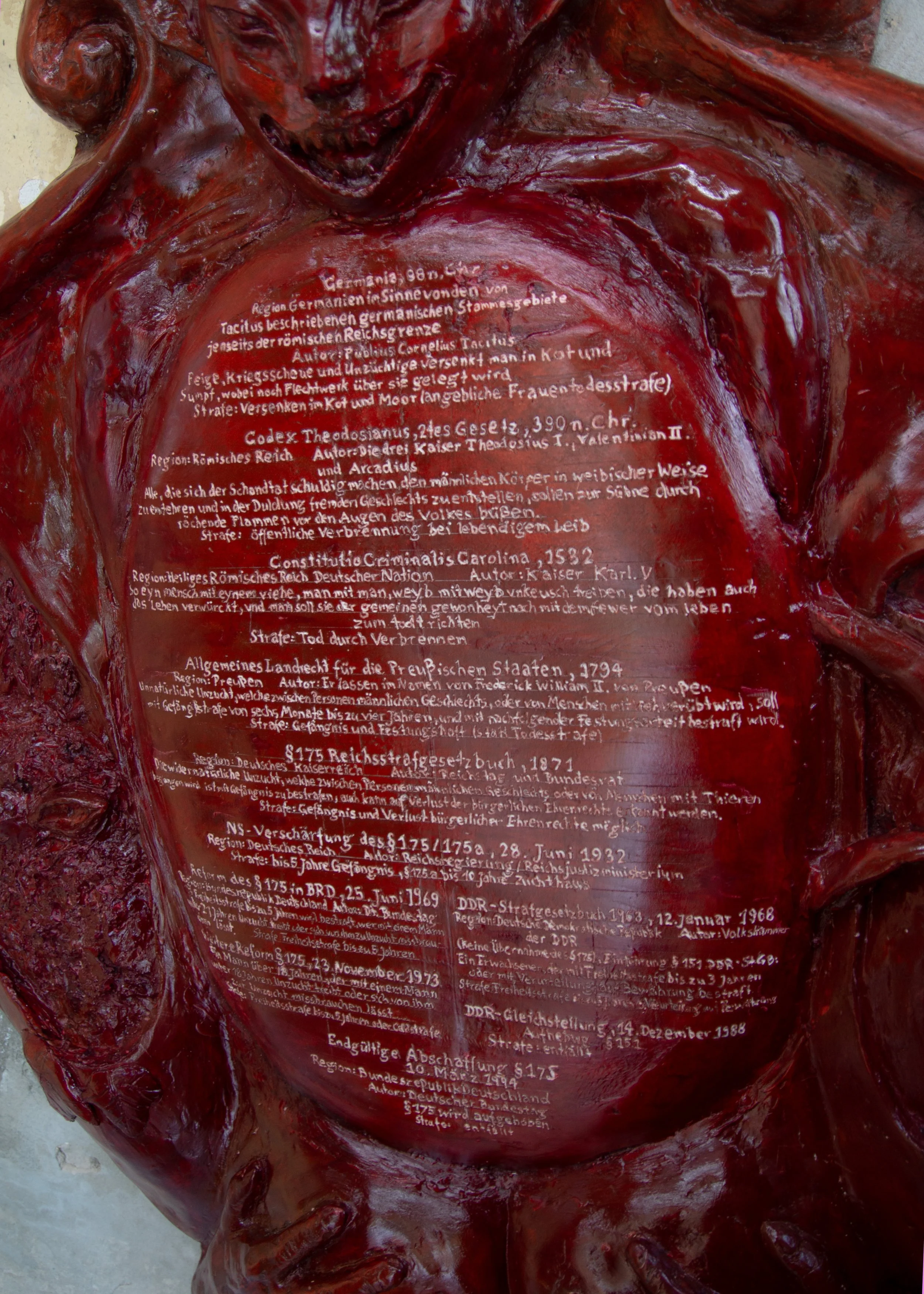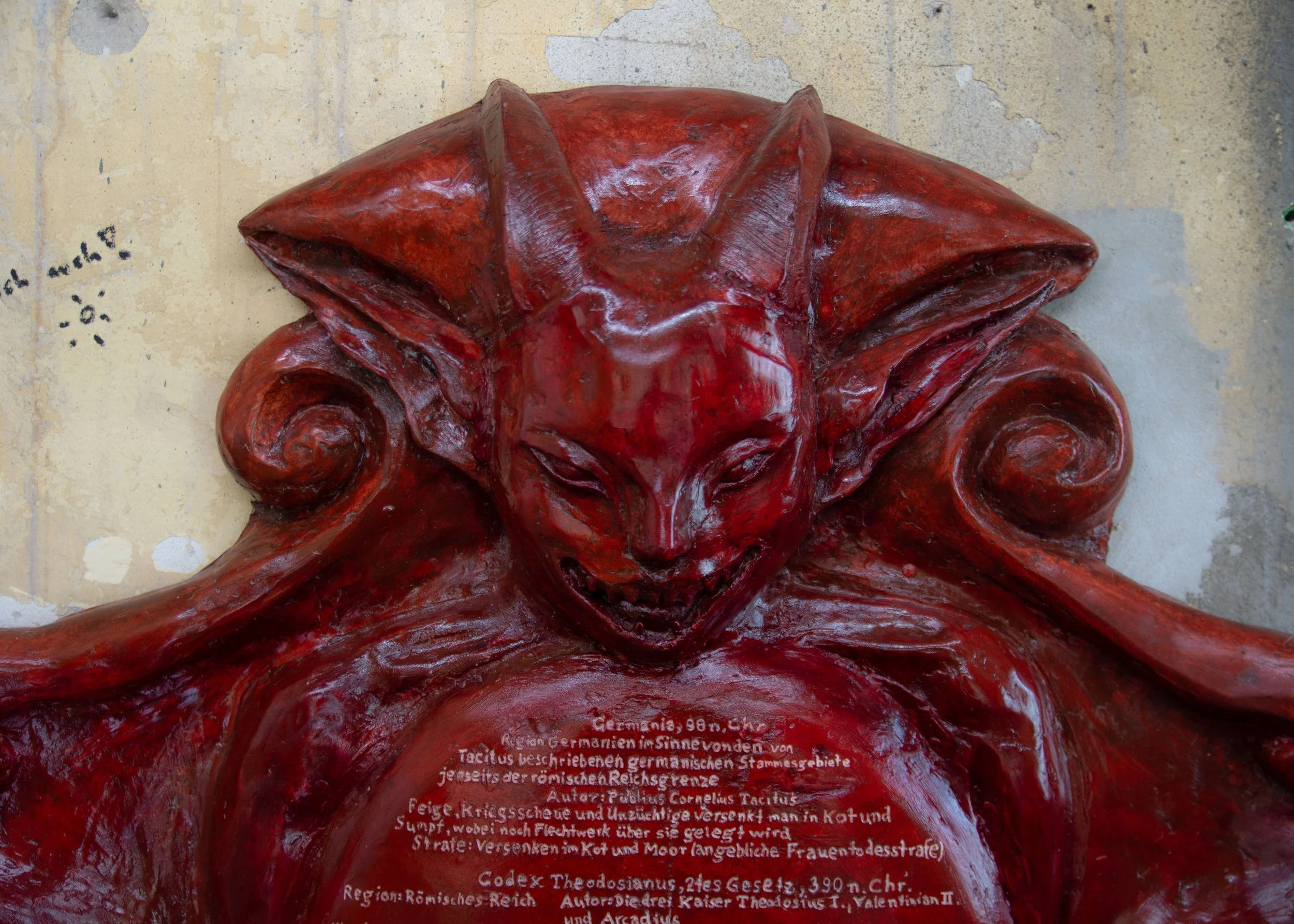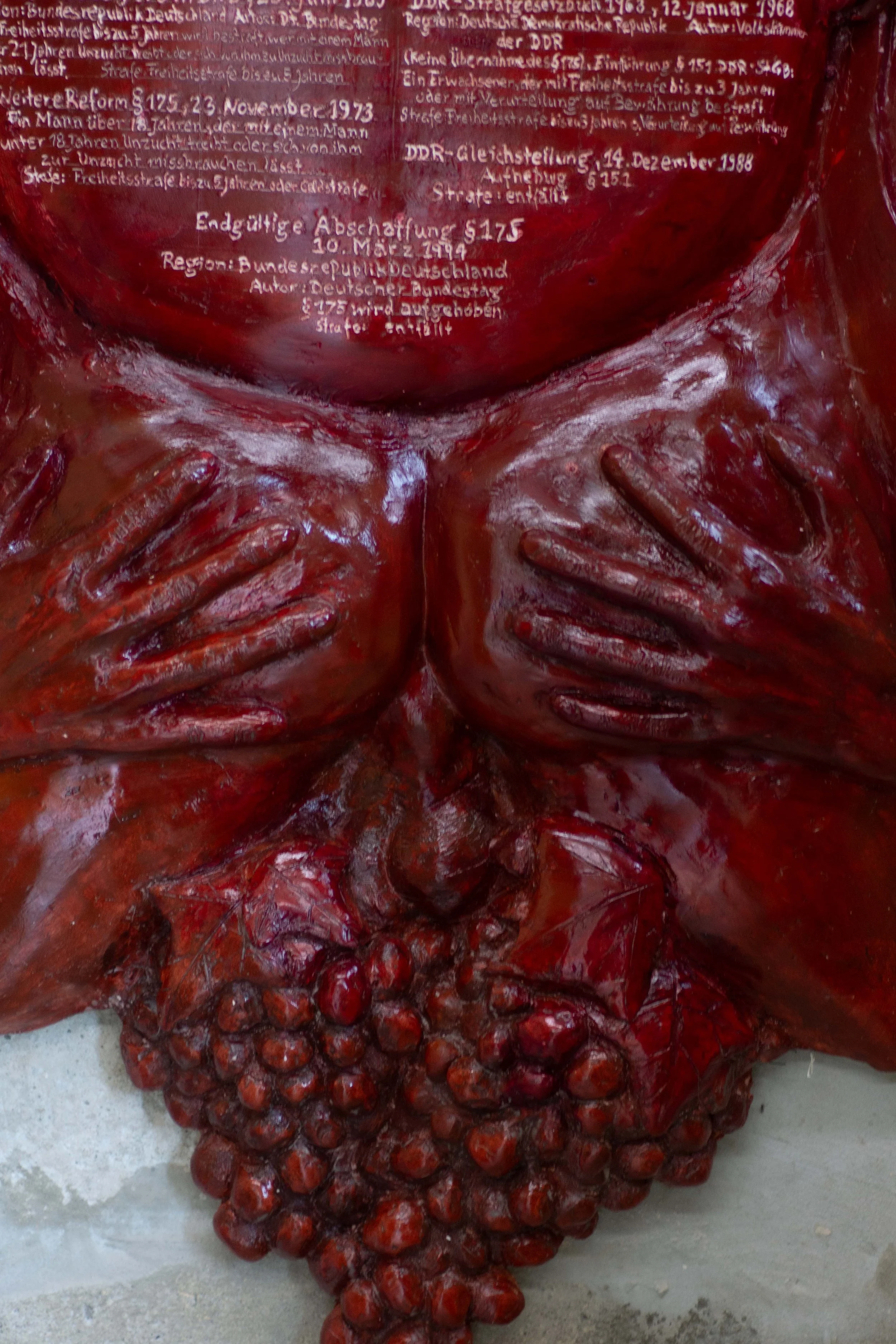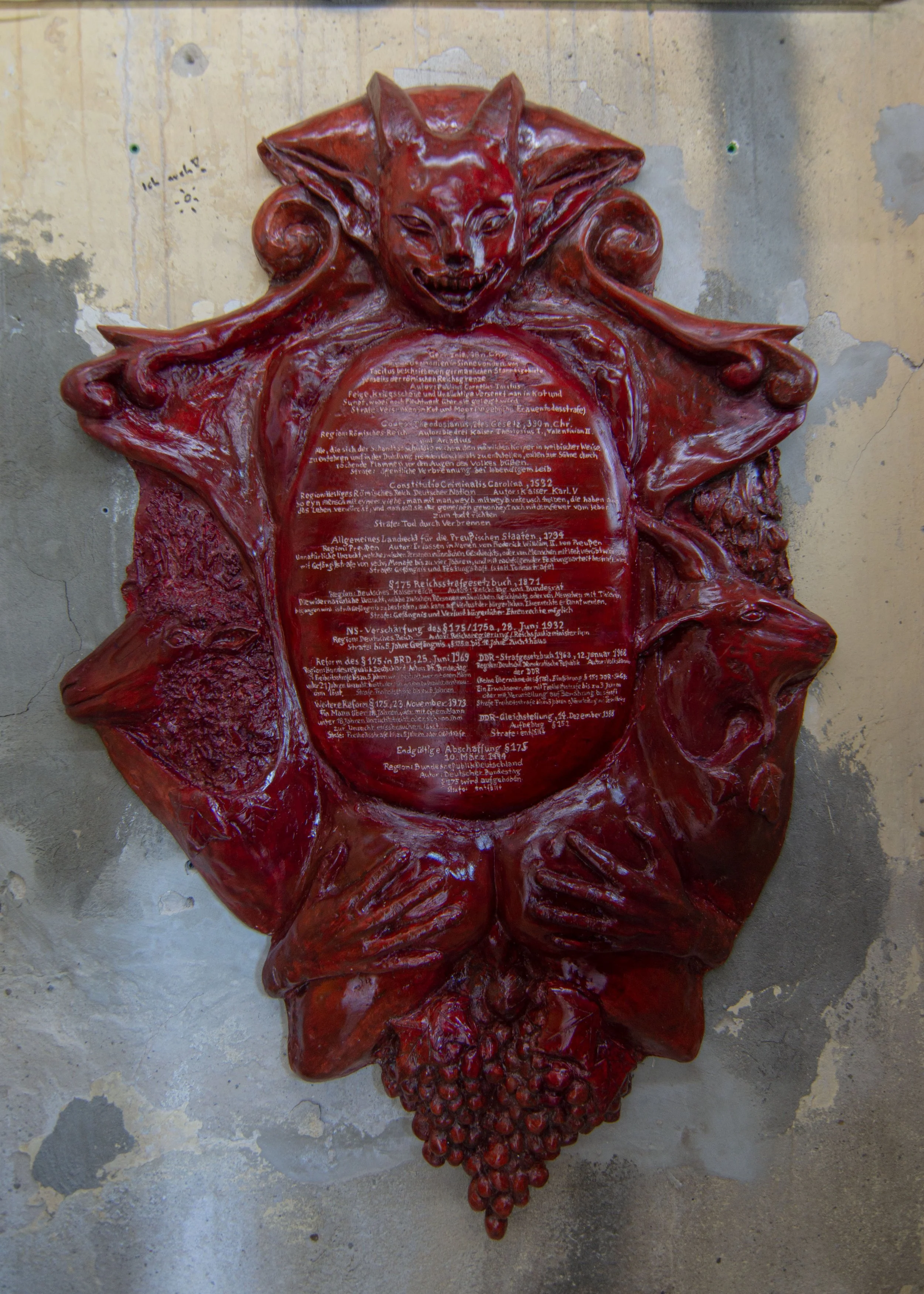
Widernatürliche Unzucht
sculpture
2026
84cm x 13cm x 126cm
polymer gypsum, marble dust, oil paint
a rough, but little list of laws and rules against homosexuals in the area of Germany
Germania
Date: 1000 BCE – 600 CE
Region: Germania, in the sense of the Germanic tribal territories beyond the Roman imperial frontier described by Tacitus
Source: “On the Origin and Character of the Germans” (De origine et moribus Germanorum, abbreviated as Germania), written in 98 CE
Author: Roman historian Publius Cornelius Tacitus
Quote: Chapter 12: “Proditores et transfugas arboribus suspendunt, ignavos et imbelles et corpore infames caeno ac palude, iniecta insuper crate, mergunt.” = Cowards, those unwilling to fight, and those infamous for bodily dishonour are submerged in mud and swamp, with a wicker structure placed over them.
Punishment: Public punishment by submersion in mud and swamp (allegedly the typical punishment for women)
Codex Theodosianus 9.7.3
Date: 342 CE
Region: Roman Empire
Source: Codex Theodosianus 9.7.3, Book IX, Title VII, Law III (9.7.3), Mommsen / Meyer (eds.), The Sixteen Books of the Theodosian Code
Authors: Constantius II and Constans
Quote: “Cum vir nubit in feminam, feminam se gerens, quid cupiat nescitur, ubi sexus perdidit locum: iubemus insurgere leges, armari iura gladio ultore, ut exquisitis poenis subdantur infames, qui sunt vel fuerint rei.”
= “When a man marries as a woman, assuming the role of a woman, what does he desire, when sex has lost its place? We order the laws to rise up, the laws to be armed with the avenging sword, so that those who are or have been guilty may be subjected to the most severe punishments.”
Punishment: Implication of the death penalty / possibly decapitation
Second Law under Theodosius I, Valentinian II and Arcadius
Date: 390 CE
Region: Roman Empire
Source: Codex Theodosianus, Book IX, Title VII, Law VI (9.7.6), Theodor Mommsen / Paul Meyer, The Sixteen Books of the Theodosian Code
Authors: The three emperors Theodosius I, Valentinian II and Arcadius
Quote: “Omnes, quibus flagitii usus est virile corpus muliebriter constitutum alieni sexus damnare patientia ... flammis vindicibus expiabunt in conspectu populi.”
= “All those who are guilty of the disgraceful act of dishonouring the male body in an effeminate manner and defiling it through submission to another sex shall atone through avenging flames before the eyes of the people.”
Punishment: Public burning alive
Constitutio Criminalis Carolina
Date: 1532
Region: Holy Roman Empire
Source: Constitutio Criminalis Carolina, Article / §116, The Constitutio Criminalis Carolina of Emperor Charles V
Author: Emperor Charles V
Quote: “So eyn mensch mit eynem viehe, man mit man, weyb mit weyb vnkeusch treiben, die haben auch das leben verwürckt, vnd man soll sie der gemeinen gewonheyt nach mit dem fewer vom leben zum todt richten.”
= If a person commits lewdness with an animal, a man with a man, or a woman with a woman, they have forfeited their lives, and according to common custom they shall be sentenced to death by fire.
Punishment: Death by burning
General Prussian Law
Date: 1794
Region: Prussia
Source: General Prussian Law for the Prussian States, Part II, Title 20
Authors: Enacted in the name of Frederick William II of Prussia; primarily drafted by Carl Gottlieb Svarez and Ernst Ferdinand Klein
Quote: “Unnatürliche Unzucht, welche zwischen Personen männlichen Geschlechts, oder von Menschen mit Vieh verübt wird, soll mit Gefängnißstrafe von sechs Monaten bis zu vier Jahren, und mit nachfolgender Festungsarbeit bestraft werden.”
= Unnatural „Unzucht“ committed between persons of the male sex, or by humans with animals, shall be punished by imprisonment for a period of six months to four years, followed by confinement in a fortress.
Punishment: Imprisonment / imprisonment in a fortress (instead of the death penalty)
§175 German Criminal Code
Date: 1871
Region: German Empire (adopted from Prussian law)
Source: Criminal Code for the German Empire (1871), §175, Reich Law Gazette 1871, p. 127
Authors: Reichstag and Bundesrat
Quote: “Die widernatürliche Unzucht, welche zwischen Personen männlichen Geschlechts oder von Menschen mit Thieren begangen wird, ist mit Gefängnis zu bestrafen; auch kann auf Verlust der bürgerlichen Ehrenrechte erkannt werden.”
= Unnatural „Unzucht“ committed between persons of the male sex or by humans with animals shall be punished by imprisonment; the loss of civil rights may also be imposed.
Punishment: Imprisonment and possible loss of civil rights
Nazi Intensification of §175/175a
Date: 28 June 1935
Region: German Reich
Source: Revised §175 / §175a of the Criminal Code, Reich Law Gazette Part I, 1935, p. 839
Authors: Nazi regime
Quote: “Ein Mann, der mit einem anderen Mann Unzucht treibt oder sich von ihm missbrauchen lässt…”
= A man who engages in "Unzucht“ with another man or allows himself to be sexually abused by him…
Punishment: Up to 5 years imprisonment; §175a up to 10 years in a penitentiary
Reform of §175 in the Federal Republic of Germany
Date: 25 June 1969
Region: Federal Republic of Germany
Source: Criminal Code, “First Law on the Reform of Criminal Law,” Federal Law Gazette Part I, 1969, p. 645
Author: German Bundestag
Quote: “Mit Freiheitsstrafe bis zu fünf Jahren wird bestraft, wer mit einem Mann unter einundzwanzig Jahren Unzucht treibt oder sich von ihm zur Unzucht missbrauchen lässt.”
= Anyone who engages in „Unzucht“ with a male under the age of twenty-one or allows himself to be sexually abused by him shall be punished with imprisonment of up to five years.
Punishment: Imprisonment of up to 5 years
Further Reform of §175
Date: 23 November 1973
Region: Federal Republic of Germany
Source: Criminal Code, “Fourth Law on the Reform of Criminal Law,” Federal Law Gazette Part I, 1973, p. 1725
Author: German Bundestag
Quote: “Ein Mann über achtzehn Jahre, der mit einem Mann unter achtzehn Jahren Unzucht treibt oder sich von ihm zur Unzucht missbrauchen lässt…”
Punishment: Imprisonment of up to 5 years or a fine
GDR – Criminal Code of 1968
Date: 12 January 1968
Region: German Democratic Republic (GDR)
Source: Criminal Code of the GDR
Author: People’s Chamber of the GDR
Quote: No adoption of §175; instead, §151 of the GDR Criminal Code was introduced:
“Ein Erwachsener, der mit einem Jugendlichen gleichen Geschlechts sexuelle Handlungen vornimmt, wird mit Freiheitsstrafe bis zu drei Jahren oder mit Verurteilung auf Bewährung bestraft.”
= “An adult who engages in sexual acts with a young person of the same sex shall be punished with imprisonment of up to three years or with a suspended sentence.”
Punishment: Imprisonment of up to 3 years or a suspended sentence
GDR – Equalisation in 1988
Date: 14 December 1988
Region: German Democratic Republic (GDR)
Source: Criminal Code of the GDR
Author: People’s Chamber of the GDR
Quote: Abolition of §151
Punishment: None
Federal Republic of Germany – Final Abolition of §175
Date: 10 March 1994
Region: Federal Republic of Germany
Source: Criminal Code (FRG), Law on the Repeal of §175, Federal Law Gazette Part I, 1994, p. 1168
Author: German Bundestag of reunified Germany
Quote: “§175 wird aufgehoben.”
= “§175 is hereby repealed.”
Punishment: None
The rich ornamentation emphasises supposed subplots: whilst the devil laughs down from above, the sheep and goat are surrounded by herbs, alluding to the herbalist, a figure who, historically, was often sentenced to death as a witch. The buttocks, spread apart by hands in the lower section, echo both the exhibition’s subtitle and the content of the centrally placed text panel. The term Unzucht was used in numerous religions, as well as in state edicts and laws, to encompass reprehensible sexual acts, including sodomy – a synonym for anal intercourse between homosexuals – but also sex outside marriage
Text by Johanna Engemann