The Parable of the Blessed and Cursed
photography
2025
photography by Feyd Angels
light design by Liza Root
styling by Kelsey Finn
ENG
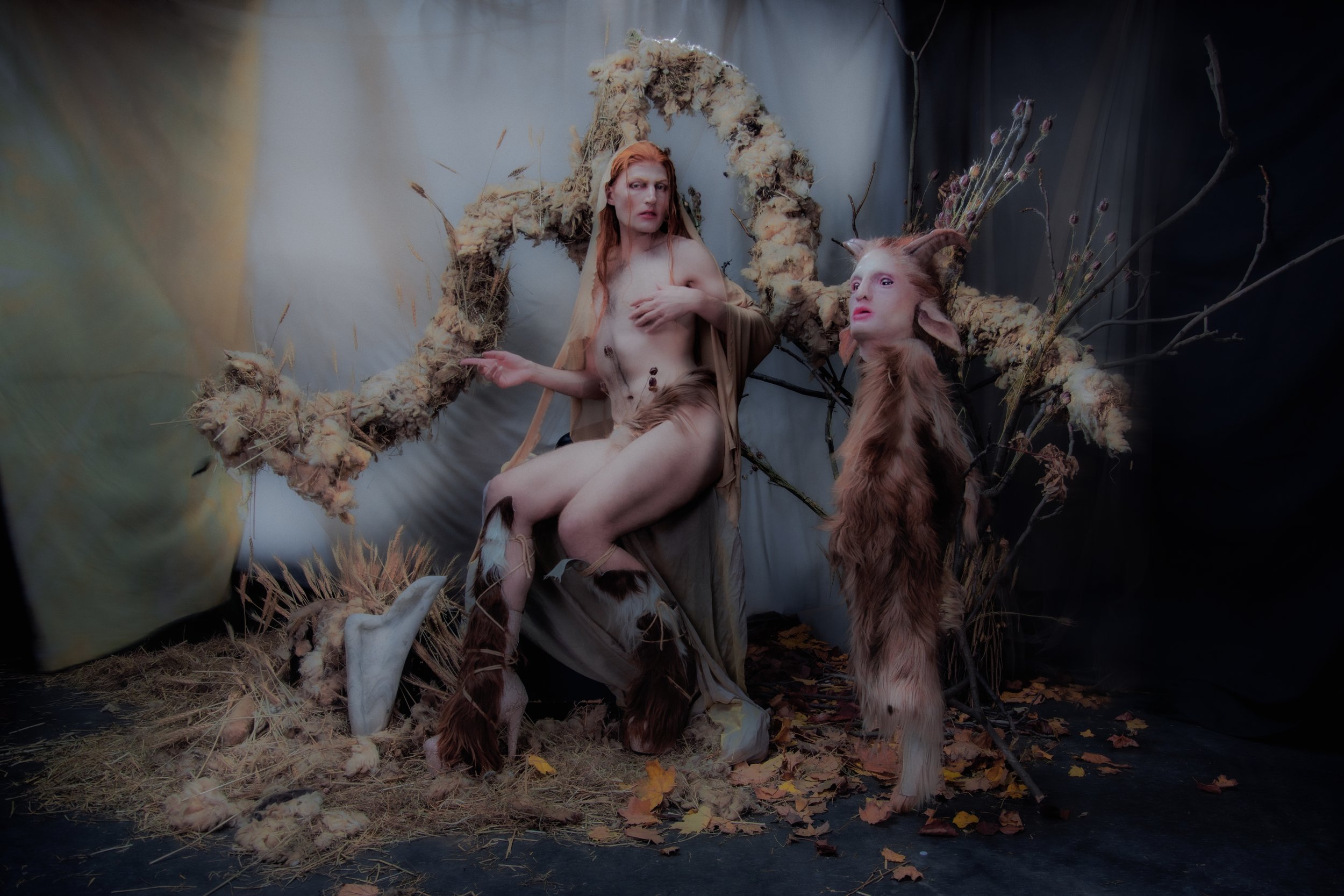
In the biblical parable, the good shepherd separates the “righteous” sheep from the “corrupt” goats, referring to the moral order before the Last Judgment and determining who is considered valuable, pure, or sinful. In this work, the Christian motif of the good shepherd is reinterpreted, with Itchi positioning themself at the center between the values of good and evil. A form constructed from sheep’s wool and hay runs through the image, with additional wool and grain appearing on the left as symbols of abundance and a good harvest. On the right, a silicone duplicate of Itchi’s head appears, extended with goat horns, eyes, and ears, with goat and human hair embedded into its surface. This shows the transformation from human to goat, which carries negative connotations in Christian symbolism and represents stubbornness, wildness, or even something devilish and evil. Itchi wears red hair, as well as goat skins around their high heels.
The work explores how queer, nonbinary, and trans bodies continue to be automatically assigned to the side of the “sinful,” much like the goats in the parable. At the same time, it references the iconographic proximity to Pan and satyr figures, which were demonized by Christianity as wild, uncontrolled beings driven by desire. The feminine figure and red hair also reference the burning of witches in the Middle Ages, when many women were demonized and sentenced to death for various, often absurd reasons.
DE
In der biblischen Parabel trennt der gute Hirte die „gerechten“ Schafe von den „verderbten“ Ziegen, welches sich auf die moralische Ordnung vor dem dem Jüngsten Gericht bezieht und entscheidet, wer als wertvoll, rein oder sündhaft gilt.
In dieser Arbeit wird das christliche Motiv des guten Hirten neu interpretiert und Itchi positioniert sich hierbei selbst im Zentrum zwischen den Werten gut und böse. Eine aus Schafswolle und Heu konstruierte Form durchzieht das Bild und findet auf der linken Seite weitere Wolle und Getreide als Symbole von Fülle und guter Ernte. Rechts erscheint ein Silikon-Duplikat von Itchis Kopfs, welcher mit Ziegenhörnern, -augen und -ohren erweitert wurde und in dessen Oberfläche Ziegen- und Menschenhaare gestochen wurden. Hier zeigt sich die Transformation von Mensch zu Ziege, welche in christlicher Symbolik negativ konnotiert ist und für eigensinnig, wild, oder sogar teuflisch und böse steht. Itchi trägt rote Haare, sowie Ziegenfelle um die High Heels.
Die Arbeit thematisiert, wie queere, nichtbinäre, als auch Trans Körper bis heute, wie die Ziegen in der Parabel, automatisch der Seite des „Sündhaften“ zugeordnet werden. Zugleich wird auf die ikonografische Nähe zu Pan und Satyr-Gestalten verwiesen, die als wild, unkontrolliert und als Wesen gesteuert von Begierden vom Christentum dämonisiert wurden. Auch die feminine Gestalt und die roten Haare sind eine Referenz an die Hexenverbrennung im Mittelalter, wo viele Frauen aus diversen, meist lächerlichen Gründen dämonisiert und zum Tode verurteilt wurden.